
Why does BBC Question Time have so many right wing journalists as panellists?
And why an examination of ten years worth of data doesn't support claims it's the Nigel Farage show

In this quiet period between Christmas and the New Year, a journal has published my final article of the year - an examination of 10 years' worth of guests on Question Time.
If you can’t access academic journals, this article from The Conversation was a work in progress that examined nine years’ worth of guests.
The findings are similar:
1. While the Conservatives and Labour Party were broadly equally represented, there were big differences between the other parties. The way the producers filled the third political seat tended to benefit the SNP and penalise the Greens and the Farage-led parties.
2. Claims that Nigel Farage is on all the time are not borne out in the sample period 2014-2024. In fact, in this period, he was a less frequent guest than the former Green Party leader, Caroline Lucas.
3. The producers aim to feature a range of voices from British civil society, including academics, sportspeople, and people working in the creative industries. But the largest single group are business leaders, which far outweighs, for example, trade union leaders.
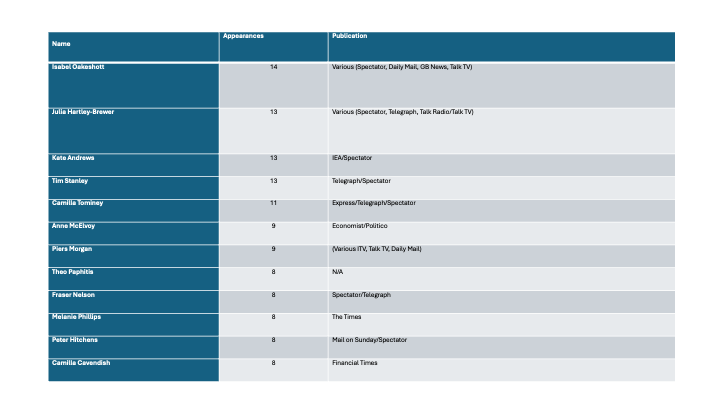
4. It is not easy to appear on Question Time, and some of the best performers are opinionated journalists. The most frequently appearing guests over the course of the decade were journalists, many of them on the right, and writers for the political magazine The Spectator.
As I argue in the article, there is a tension between the public service remit of the BBC’s journalism and the need to produce an entertaining programme for the mass-market channel, BBC1. There is sometimes too much heat and too little light. But some of the best performers on the programme are journalists who are unafraid to express controversial opinions and argue their corner. It’s the reason why people such as Isabel Oakeshott and Julia Hartley Brewer are so often booked. But the table demonstrating the frequency of some appearances should raise questions about whether the BBC is relying on too small a group of pundits:
Lots more data in the article itself - plenty to dig into.